Venizelos
In 1919, the Greek-Turkish War broke out. The war lasted until 1922 and had a significant impact on Greek culture and development. The documentary Venizelos shows us this history.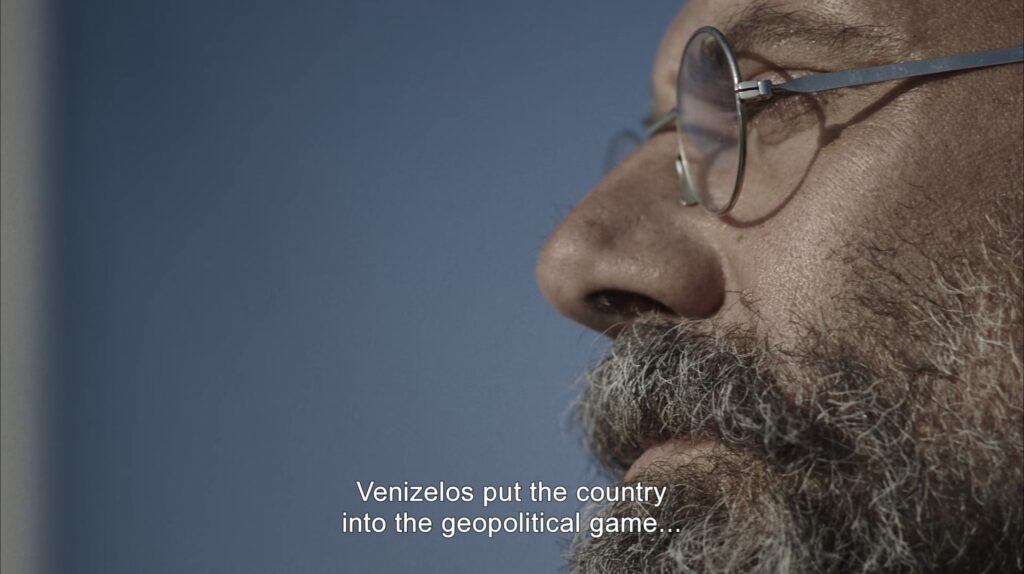
Venizelos: The Struggle for Asia Minor (docum.) – Dir. Nikos Dayandas. 84 mins. 07’05
- two reasons that cause the war:
- Geopolitics and historical issues:
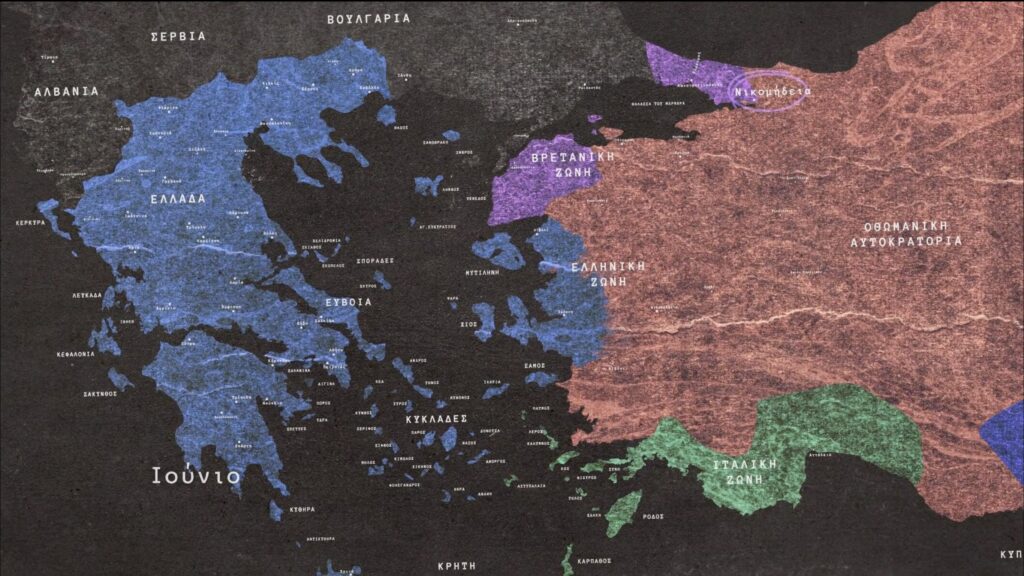
Venizelos: The Struggle for Asia Minor (docum.) – Dir. Nikos Dayandas. 84 mins. 41’32
Due to geopolitics and historical issues, Greece and Turkey have always had varying degrees of contradictions and territorial disputes. Greece received help from other European countries from 1829 to 1833 and became an independent country. ‘It was a very fact that the Kingdom of Greece incorporated at that time only around 25% of the Greeks who were living at the Balkans and Asia Minor (the Near East). Such situation created tensions between Greece and the Ottoman Empire as the Greeks wanted their total national unification’ (Sotirovic, 1). In the early 20th century, Venizelos became the leader of Greece. He supported Idea of Great Greek and had a strong sense of national mission. Under the leadership of Venizelos, in 1919, Greece attacked and occupied part of Turkey's territory with the consent of the allies. As the war deepened, the Turkish army gradually gained the upper hand and finally defeated the Greek army. - Ideology:
‘We observe the awakening of Serbian nationalism…as well as the emergence of a significant Bulgarian vision…and we also see the Greek ‘Megali Idea’, Greece’s Great Idea of Expansion’ (Dayandas, 3’54). Greek ideology gradually developed into expansionism similar to nationalism in the 19th and 20th centuries. ‘The proponents of Megali Idea, in other words, aspired to unite within the borders of a single national political unity all the areas of Greek settlement in the Near East’ (Sotirovic, 1). The deep-rooted sense of responsibility in the Greek identity makes people regard the recovery of more territories that once belonged to Greece as their responsibility and want to restore the prosperity of the country. ‘By 1912, the new Greek territories included Crete, the islands of the Eastern Aegean, Epirus, and Macedonia (Dayandas, 8’05). The rapid expansion led to Turkey's dissatisfaction, and the increasing tension between the two countries eventually led to the war.The development of The Greece's Great Idea of Expansion may have been influenced by the prevailing ideology in Europe at that time. ‘with its attendant phenomena of competition and militarism, which grew in strength through all Europe during the course of the by-and-large comparatively peaceful nineteenth century but then explodes catastrophically in the two world wars that disfigured the first half of the twentieth century’ (Zacharia, 151). Context is important for the study of a civilization, because a civilization does not exist independently. Its period, political environment, and geographical factors will become the context that affects its development. In the 19th and 20th centuries, the context of Greece was complex and tense. Europe's general attitude towards war and territorial expansion undoubtedly affected Greece, which explains why Greek ideology is eager to expand at this time.- the result of the war:
In 1923, Greece had to accept the defeat and start negotiations with Turkey. Under pressure from many parties, Greece and Turkey exchanged millions of people for peace. At this time, the Greek ideology did not change from the previous expansionism, ‘Greece had the megali idea which carried certain peculiarities of the expansionist approach into their foreign policy. In that time, Greece tried to achieve domination over Western Thrace and control the Turkish government with the population of Rums who lived in İstanbul’ (Yahya, 13). Despite the failure of the war, the country led by Venizelos is still thinking about how to use the population exchange to gain more opportunities for expansion, which also shows the depth of Greece's acceptance by the Idea of Great Greek and its ideological roots in identity. - transformation of identity after the war:
However, with the advancement of history, Greece's ideology in the field of diplomacy has changed. ‘The key point that caused change in the Greek foreign policy approach was the increasing other threats which came from Bulgaria and Italy. Increasing fascism in Europe reached the radical level and especially Mussolini carried this ideology to procure Mediterranean territory. After these security problems that Greece faced, Greek policy makers decided to move their foreign policy agenda to security maximization’(Yahya, 13). External factors eventually led to a change in Greek ideology, which also affected the development of Greece in the next century. After experiencing the war and facing various threats, people deeply feel the destruction of civilization by war. Instead of Wanting to expand or establish Great Greece, people become more conservative and think more about a safe and stable living environment. - Proof of the development on inclusiveness of Greek identity
In 2015, a large number of refugees poured into Greece. At this time, the Greek government was still dealing with the impact of the economic crisis, and the Greeks also faced many social problems and economic difficulties. For Greece, receiving refugees means that employment, education, and welfare will be affected. However, the Greek government chose to include refugees. In some areas where refugees may appear, the Greek government organized rescue teams to patrol to prevent refugees from losing their lives in the sea. At the same time, the Greek government also provides education for refugee children. ‘In March 2016, the Ministry of Education decided to prepare a plan for the integration of refugee and asylum-seeker children into the Greek educational system and shortly in Autumn 2016 established the Reception Facilities for Refugee Education (DYEP) for refugee children residing in the refugee camps. In parallel, the institution of the Refugee Education Coordinator (REC) was established. RECs are permanent teachers of the Ministry of Education and are positioned in each refugee camp in order to facilitate refugee children's school enrollment and attendance’ (Konstantinos, Paida, 82). After a period of population exchange, the Greeks were composed of descendants of different races, which enhanced their tolerance for other ethnic groups. Plus, the Greeks who were exchanged to Turkey also faced the difficulties these refugees are facing now, which enables them to understand the situation of the refugees. The help to refugees not only shows the process of reshaping Greek identity, but also reflects the inclusiveness in Greek identity.Black Stone
The film Black Stone can well explain the role of inclusiveness in Greek identity. It tells the story of a Greek mother, her disabled son Lefteris, looking for the mother's other son with the black driver Michalis.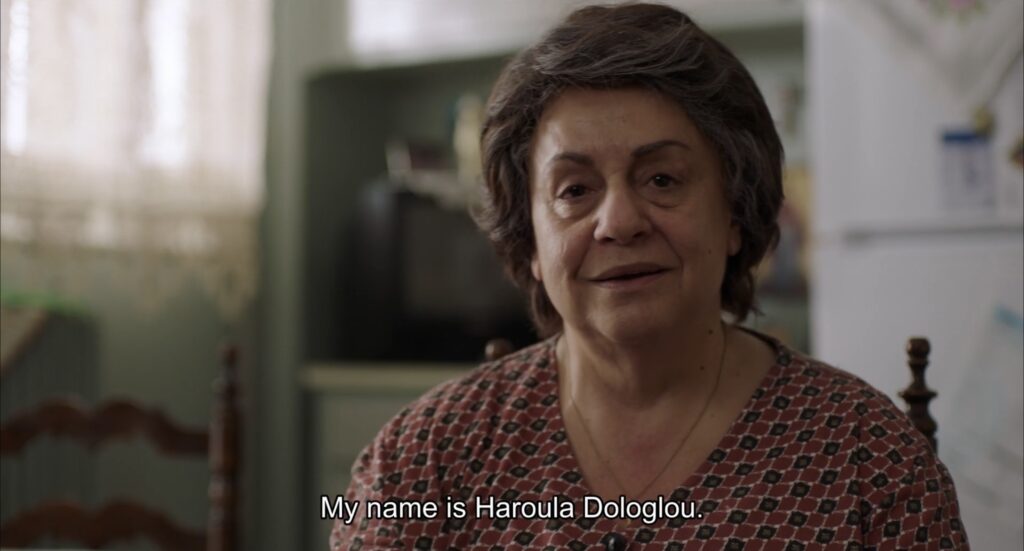
Black Stone (fiction) – Dir. Spiros Jacovides. 96 mins. 05’20
- Xenophobias or inclusiveness?
The mother seemed a little impatient when she accepted Michalis's help at the beginning. When Michalis came to his mother's house with the photographer, his mother was puzzled and impatiently asked the photographer if the black driver was Greek (Jacovides 32'35). Obviously, the mother judged from Michalis's skin color that he was not Greek. Stuart Hall believes that ‘In a way, what we are saying now is that representation doesn't really capture the process at all, because there was nothing absolutely fixed there in the first place to represent’(Hall, 15’40). As a representation, skin color does not represent the identity of Michalis. When a black man was born and raised in Greece, we should pay more attention to his self-knowledge in Greek culture than some innate representations. In addition, her mother also told Michalis that she had no money to pay for his help (Jacovides, 33'37). The mother's attitude shows her distrust of Michalis, which is mainly due to her unfamiliarity with Michalis and Michalis's skin color. When seeing a stranger with a different skin color, the mother didn't want to know more about him. Hall believes that, ‘The representation of ‘difference’ through the body became the discursive site through which much of this ‘racialized knowledge’ was produced and circulated’(Hall, 223). After leaving the mother's house and taking a taxi, Michalis did not show anger or sadness. Instead, he understood the mother's thoughts and defined it as 'Xenophobia', ‘Xenophobia is the word itself says it all. They are afraid of something they have never seen before’ (Jacovides, 33’56). Although the mother did not know Michalis, she still made food for him when he came to her house for the second time and gradually embraced him. The mother's performance proves the friendliness and tolerance of the Greeks. Sometimes, Xenophobia is labeled as exclusiveness or racist, which is undoubtedly unfair. Compared with his mother's Xenophobia, Lefteris has a completely different attitude towards Michalis. Instead of didn't trust him at the beginning, Lefteris and Michalis became good friends. They watched TV and smoke together, which also made Michalis slowly integrate into the family. In the end, the mother regarded Michalis as her child.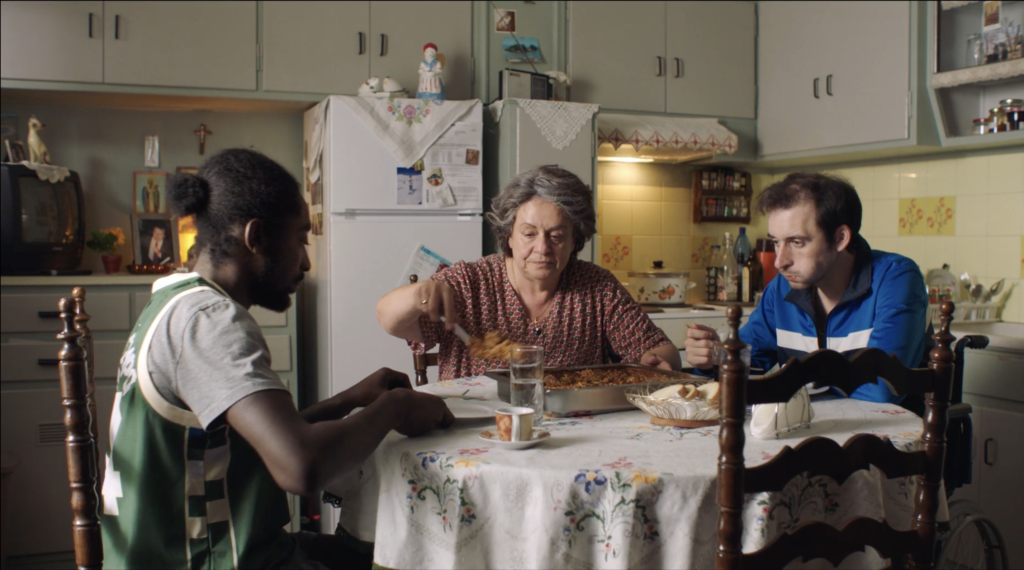
Black Stone (fiction) – Dir. Spiros Jacovides. 96 mins. 35’31
The film shows the inclusiveness of the Greeks, and at the same time, it is also the epitome of the national integration after the population exchange. In the face of different cultures and representation, many people will choose to reject it at the beginning. However, with the deepening of exchanges between these ethnic groups, people began to understand the culture of other ethnic groups. They no longer pay attention to the representation of appearance, but more attention to their spiritual core. After generations of integration, new cultures, ideologies, and identities are built, which echoes the plot of Black Stone. The mother used to live in the era when the population exchange had just been completed, so she was influenced by stereotypes and misunderstood the culture of other ethnic groups. Although society has gradually embraced other cultures as it develops, all stereotypes and misunderstandings have a certain lag, which makes some people still unwilling to understand other ethnic groups. Lefteris, the representative of the next generation, lives in a period of national integration and completion. The new generation has a more inclusive concept, which represents a shift in Greek ideology. Like Michalis, the Turks who were exchanged to Greece gradually became an indispensable part of building a new culture from the beginning. The integration reflects the inclusiveness of other cultures in Greek identity to a certain extent.- transformation of Greek identity
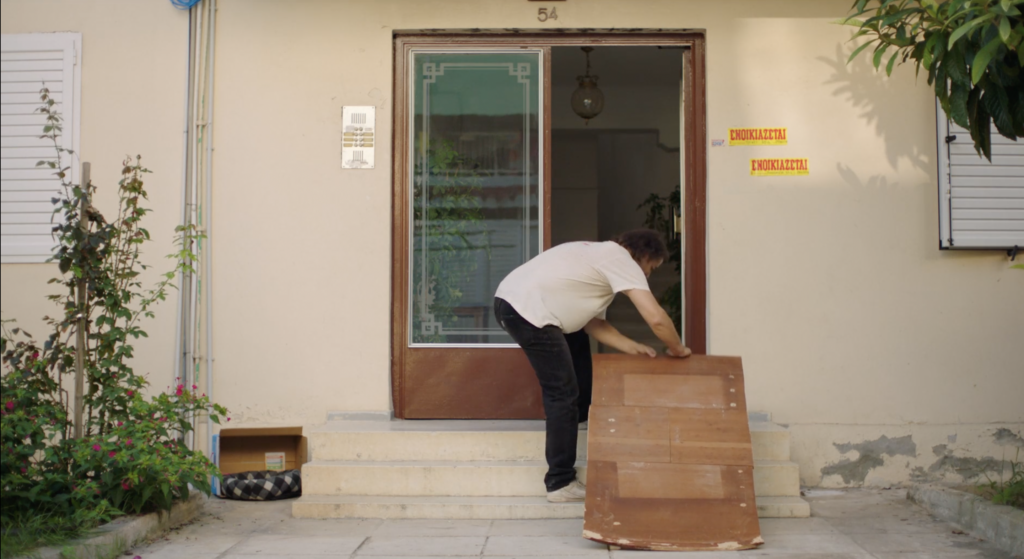
Black Stone (fiction) – Dir. Spiros Jacovides. 96 mins. 1’22’49
At the end of the movie Black Stone, Panos returned home after his mother died. After a few days of pain, he cheered up again. Panos remade a slope for his brother that could help him go upstairs (Jacovides 1'22'49). He brought everyone together. Whether it is his disabled brother, a wife with different skin colors, children, and Michalis, they unite and start a new life. The ending of the film reflects the scene of the Greeks rebuilding their homes after the economic crisis, which reflects the Greeks' optimism, unity, and fearless spirit of difficulties. At the same time, the desire to recover the former territory in Greek identity gradually disappeared with the disaster caused by the war and the economic crisis, which completed the reshaping of Greek identity.Purgatory

Purgatory (fiction) – Dir.Vassilis Mazomenos. 26’29
The film Purgatory (2023) reflects people's psychological state and identity during this period. Purgatory consists of seven stories, and each story reflects people's helplessness and confusion in life. One of the stories tells the story of a girl who was abandoned by her father when she was a child working in a brothel. One day, her father found her in a brothel and wanted to take her away. Her father angrily beat the manager of the brothel and the man who was going to have sex with the girl (Mazomenos, 31'45). His performance shows that he still loves and wants to protect his daughter. However, the girl could not forgive her father for abandoning her, but after a difficult ideological struggle, she chose to accept her father and return to her normal life. The phenomenon of parents abandoning their children is not unique to Greece. But combined with his father's behavior, he had to choose this for some special reasons. Plus, given the background of the film, the father's choice is likely to be affected by the economic crisis. The Greek economic crisis has made similar events no longer an independent problem, but a social problem tied to it. Another story is that two young people injured a woman while participating in the riot. 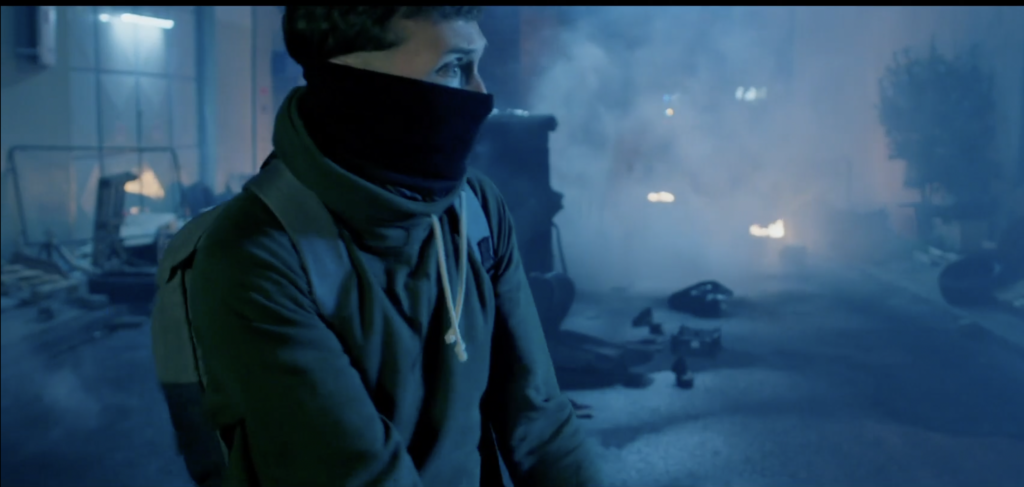
Purgatory (fiction) – Dir.Vassilis Mazomenos. 30’25
After that, in the imagination of one of them, his mother said to him, 'what about your exam? You promised to stay in and study’ (Mazomenos, 31’45). Many young people were involved in the riots. They were supposed to study in school, but they were involved in the riots because of the social turmoil. They didn't know the meaning of the action, but followed the crowd to vent their confusion and helplessness. Their actions did not make the country better, but hurt innocent people and exacerbated social unrest. These stories became the epitome of Greece's identity after the economic crisis.